Author : Kavita Madipalli – Research Scholar , Dept of Biotechnology , Ajeenkya D Y Patil University , Pune .
Introduction
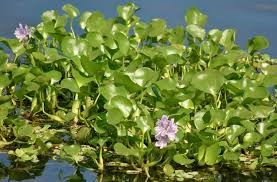
Water hyacinth (Eichhornia crassipes) is among the world’s most aggressive aquatic weeds. In India it has proliferated across lakes, rivers and wetlands, choking navigation, degrading fisheries and worsening water quality in locales as diverse as Vembanad Lake (Kerala), Powai Lake (Mumbai), and multiple inland reservoirs and urban ponds (Simpson et al., 2022; Times of India, 2025). At the same time, countries such as Bangladesh have long turned the same biomass into productive floating gardens and compost systems that support food security and livelihoods. By studying and adapting Bangladesh’s low cost techniques, India can convert repeated removal costs into community assets while protecting its freshwater systems. (MDPI)
The scale of the problem in India
Indian water bodies show recurring outbreaks of water hyacinth driven by nutrient pollution (untreated sewage and agricultural runoff), warm climates, and disrupted hydrology. In Kerala, Vembanad Lake has experienced serious infestations that impair fisheries and ecosystem services (Arunpandi et al., 2022). Urban lakes such as Powai have required large-scale mechanical removals, yet the weed often returns because pollution sources remain unaddressed (Times of India, 2025). Authorities frequently spend substantial public funds on removal operations that provide only temporary relief unless paired with upstream pollution control and productive utilization of removed biomass. (PubMed)
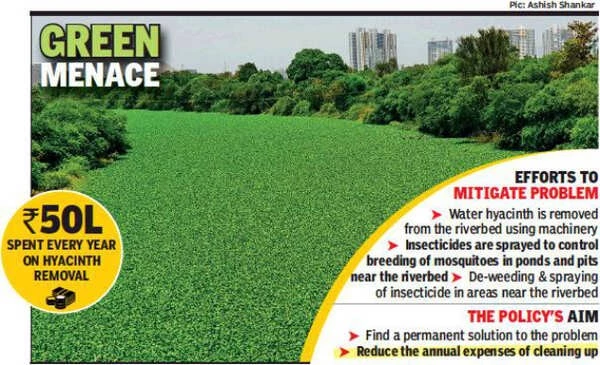
Source : https://timesofindia.indiatimes.com/city/pune/officials-devise-policy-to-find-solution-to-hyacinth-problem/articleshow/64212010.cms
What Bangladesh does: floating gardens and circular use of biomass
In flood prone areas of Bangladesh, communities have long practiced floating agriculture (locally called baira or dhap): mats or rafts are constructed from weeds (including water hyacinth), paddy straw and other plant residues, sometimes enriched with manure and silt; these rafts form buoyant, nutrient rich beds for transplanting vegetables (FAO, 2011). This approach converts an abundant nuisance into a platform for year round vegetable production, improves household diets and provides income for landless and flood affected families (FAO, n.d.). Bangladesh also promotes composting, biogas and small-scale enterprises using hyacinth fibre for crafts and paper, closing resource loops rather than burning or landfilling the biomass. (FAOHome)
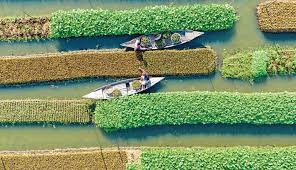
Source : https://www.daily-sun.com/printversion/details/824481
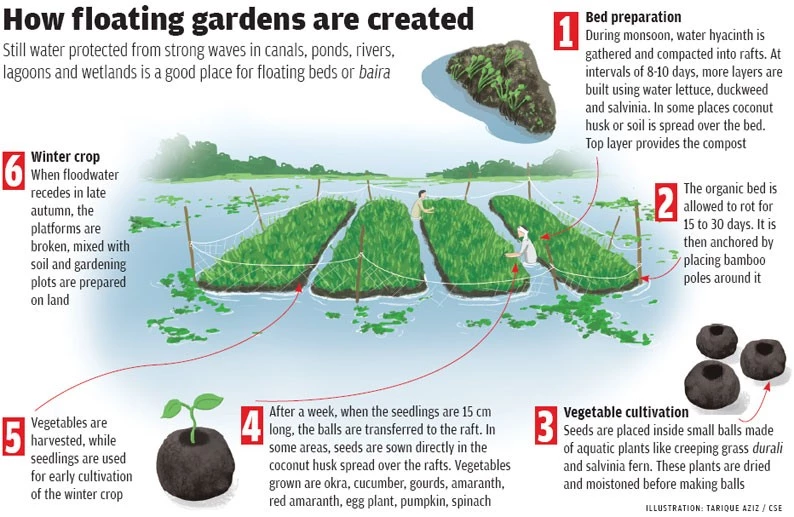
Source: https://gca.org/these-farmers-in-bangladesh-are-floating-their-crops-to-adapt-to-climate-change/
Why the Bangladesh model suits many Indian contexts
Several features make the Bangladesh approach attractive for India: first, the raw material (water hyacinth) is widely available at low or no cost; second, the technology is labour intensive but capital light, suitable for community groups and women’s collectives; third, floating beds are resilient to flooding and can reclaim productivity from waterlogged or otherwise unusable spaces; and fourth, co-processing the weed into compost, biogas or fiber products turns removal operations into livelihood activities (Bray, 2022; Datta, 2025). These characteristics align well with many Indian settings rural floodplains, peri-urban lakes, and wetlands where communities face land scarcity and seasonal inundation. (MDPI)
Key risks and safety considerations
Adapting the model requires caution. Water hyacinth bioaccumulates nutrients and can concentrate heavy metals or industrial pollutants in contaminated waters; using such biomass directly for food production or field compost without testing can risk contaminant transfer to crops (Datta, 2025). Therefore, sourcing protocols and basic contaminant screening must accompany any program that channels hyacinth into edible crop systems. Also, uncoordinated use can fail: simple removal followed by dumping on shore can reintroduce nutrients to drainage paths and encourage re growth. (ScienceDirect)
Practical steps for India to adapt and scale the model
- Combine removal with productive use at community scale. Municipal and village removal drives should link to immediate processing units floating raft construction, composting pits, biogas digesters, or fibre workshops rather than disposing weed as waste. This converts cost centres into income opportunities (FAO, 2011; Bray, 2022). (FAOHome)
- Prioritize water quality screening. Set simple screening criteria (proximity to industrial effluents, visible oil/discoloration) and basic laboratory testing for heavy metals where feasible; biomass from highly polluted sites should be directed to non-food uses (fuel, fiber, construction) while cleaner biomass can be used for rafts and compost (Datta, 2025). (ScienceDirect)
- Empower local collectives and women’s groups. Bangladesh shows the value of small cooperative groups managing rafts and sale of produce; in India, self help groups, gram panchayats and fisher cooperatives can be trained to construct baira, produce seed balls, and market vegetables locally. This enhances inclusion and spreads the labor burden. (Open Knowledge FAO)
- Integrate with wastewater and catchment improvements. Mechanical clearing solves symptoms; the long-term fix is reducing nutrient loading by improving sewage treatment, drainage and agricultural runoff management. Cities like Mumbai have paired hyacinth removal with sewage projects an approach India should mainstream (Times of India, 2025). (The Times of India)
- Promote research and demonstration sites. Fund pilot projects in infested wetlands (e.g., Vembanad, Chilika margins, urban lakes) to test raft designs, composting ratios, co-digesters for biogas and small industries for fiber products. Remote sensing and mapping tools can target high-value intervention areas and monitor outcomes (Simpson et al., 2022). (MDPI)
- Create market linkages and value chains. Support market access for vegetables from floating gardens and for processed hyacinth products paper, handicrafts, briquettes, or bioenergy via cooperative branding, microfinance, and municipal procurement for urban greening projects (Bray, 2022). (MDPI)
Conclusion
India’s recurring water-hyacinth outbreaks are not merely ecological headaches: they are raw material for climate-resilient, inclusive livelihood strategies if channeled correctly. The Bangladeshi floating-garden model provides tested, low cost techniques that India can adapt combined with water quality safeguards, upstream pollution control, and community empowerment. Turning a menace into an asset will demand cross-sectoral coordination municipalities, agriculture, fisheries, NGOs, and research institutions but the payoff is substantial: healthier water bodies, stronger food security for vulnerable households, and productive reuse of a pervasive invasive biomass.