The Future Isn’t Fiction. It’s a Massive Engineering, Policy, and Design Problem—And It Starts on Your Campus.
By: Mr. Shawn S. Noronha
School of Engineering
BTech AI-DS [Div-A / Year 2 : Sem 3]
Young minds do not wait for organizations to acclimate; they build the incipient decentralized ones and close the digital divide. Of course, they utilize the gregarious equity lens to innovation, ascertaining that incipient systems, like “smart cities,” will be accessible and will not become obstacles to inequality, placing inclusion as a design criterion from the outset rather than an afterthought.
There is diminutive to imagine about the future; just glitz and glamour afar: maglev trains gliding mutely on renewable puissance, concrete that can rejuvenate itself, and ubiquitous instant ecumenical connectivity of 6G.
This is not an inversion in a convoluted sci-fi story; this is the very real, urgent blueprint for the world right now, defined by Sustainable Development Goal 9 (SDG 9). 🎬
Decoding the Triad:
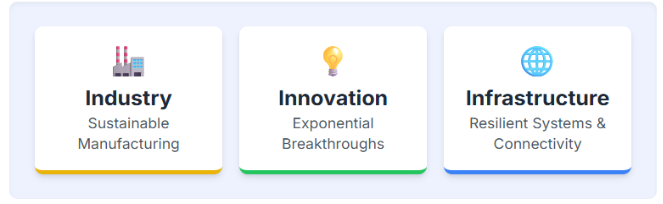
SDG 9 operates as a powerful, interconnected system. Neglect one part, and the entire structure fails.
- 1. Infrastructure (The Foundation): Building resilient systems—from physical roads to the digital backbone. The sobering truth: while 96% of the world is technically near mobile broadband, the massive digital divide is a moral failure.
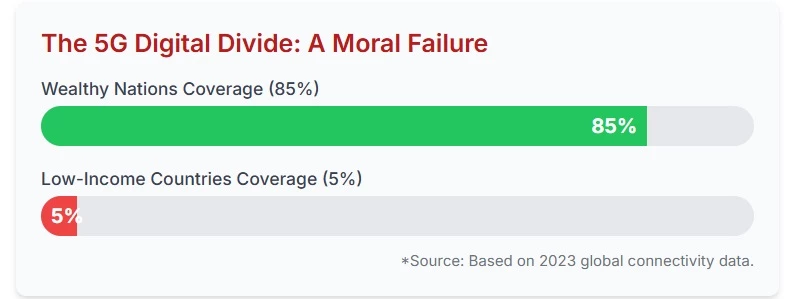
Bridging the gap is the foundational project of our generation.
- 2. Industry (The Engine): Embarking from manufacturing things to making things that last. This entails transitioning manufacturing to a sustainable framework that fosters economic magnification for everyone while safeguarding the environment.
- 3. Innovation (The Fuel): The creative power that makes the impossible possible. We are taking about exponential breakthroughs, not minute amendments to reach the 2030 goals.
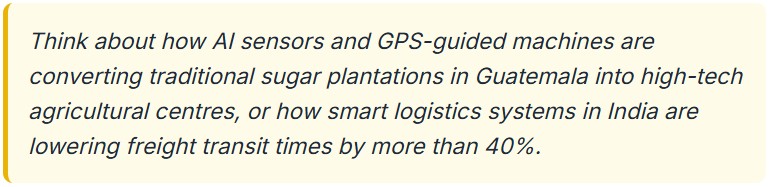
💭Maya’s vision board: A dream for 2030 (could easily become yours!)
Close your eyes and see…
Even before you wake before sunrise, the city starts harmonizing situations, giving free flow to people and vehicles. Your commute happens on solar-powered autonomous transport. The building for which you work generates more energy than it consumes. Vertical farming nourishes the city by saving 90% in water usage. Your research lab, working with AI, tackles gargantuan solutions.
Infrastructure is what one would call Fair. Ingress is free to all and sundry, irrespective of their backgrounds. Equal opportunities, equally shared connections, and equal future.
This isn’t Maya’s dream. This is YOUR blueprint. 🏗️
Your Action Plan: From Student to System Architect
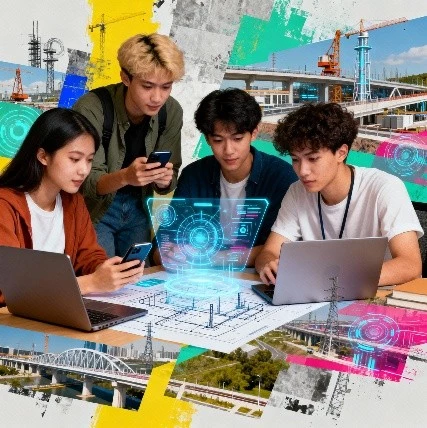
The solutions required by SDG 9, from teaching buildings to think, to ensuring every small manufacturer has access to credit are inherently complex. This makes the university environment the most critical launchpad.
We need:
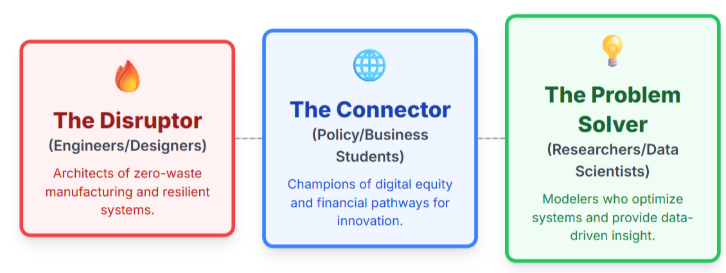
This is the infrastructure now: every connection you make, every idea you share, every solution you propose forms the human network that makes SDG 9 possible.
- Planning your sustainability project? That’s innovation infrastructure.
- Collaborating with international students? That’s global connectivity infrastructure.
- Making your one-ever video explaining climate solutions? That’s knowledge infrastructure.
The digital bridge to the future isn’t just being built by you; it is being built by you with every connection, every innovation, and every solution.
The countdown is on. Trying to get everything done on this premise of clean energy, zero-waste economies, global digital access, and a few more by 2030 without any active help-taking cannot work passively. Every research project, every interdisciplinary course selection, and every hackathon centred around local infrastructure are like micro-investments in the global blueprint.
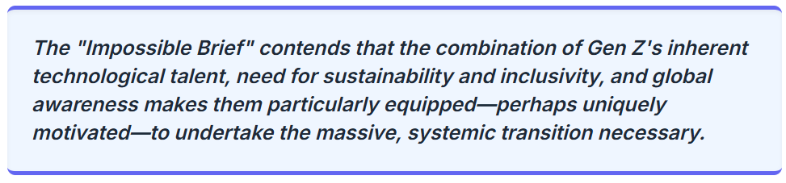
Generation Z is strategically positioned as their digital proficiency provides the “How” (Innovation), while their foundational beliefs supply the “Why” (Sustainability and Inclusivity) essential for a comprehensive redesign and establishment of the strong foundations of the 21st-century economy as detailed in SDG 9.
Innovation/Access: They harness digital technologies to develop micro-enterprise, small, mission-driven businesses-that have very low barriers to entry. Some of these businesses run on circular economy principles, the newest sustainable materials, or technology with social impact. The entrepreneurial mindset.
The resilient structure of the future won’t be poured in concrete-it will be forged in human collaboration.
Your knowledge, your network, and your resolve are the real infrastructure. The challenge is on your desk and the tools are in your hand. The time for building is now.
Name: Mr. Shawn S Noronha
Urn: 2024-B-20082006C
School: Engineering
Course: BTech Artificial Intelligence & Data Science
Year: 2nd Yr (Sem 3 / Div: A)