India’s creative economy is expanding at a rapid pace, and the media is spearheading the revolution. From social media posters to interactive websites and 3D animation, visual communication has revolutionized the manner of visual communication totally. Thus, India’s visual communication courses are also changing. Schools and best colleges for viscom in India are revising their syllabus to enable students to gain skills in line with the media scenario of today.
Here in this blog, we shall see how the researches of visual communication in India are evolving with trends in digital media, what skills are trending now, and what future awaits the students entering this thrilling industry.
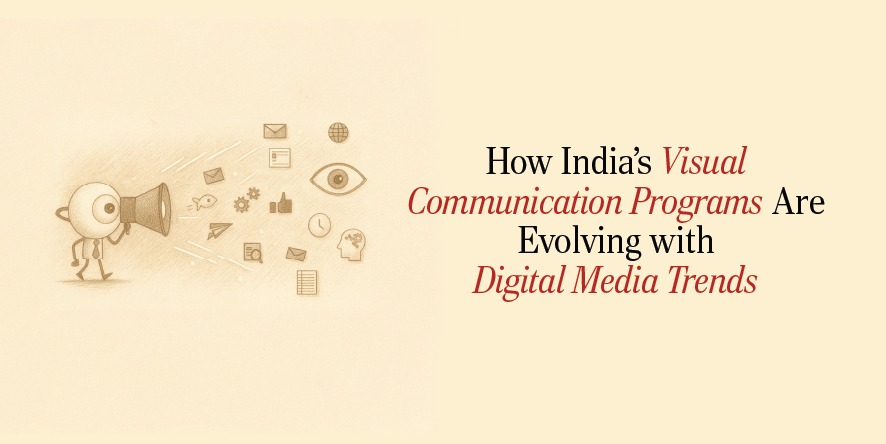
Visual communication is the art of passing ideas and information through the medium of images — photographs, film, charts, animation, and text. Students learned about print media, photography, and poster design in the past. Now, they learn about digital media platforms where images are interactive, dynamic, and tell a story in an unlimited number of ways.
Whether designing a smartphone app, creating motion graphics for YouTube, or designing brand identity on Instagram, visual communication today involves a mix of creativity and technology.
Digital media has transformed how information is being consumed. Humans now browse short videos, online ads, and interactive content every day. The revolution has compelled visual communication courses to steer away from conventional design.
The top viscom colleges in India now teach students to think visually for various digital realms — from virtual reality to social sites. The goal is to make learners ready to work competently in visual-reliant industries, motion, and stories.
Curricula today also incorporate subjects such as digital design, motion graphics, UI/UX design, social media content creation, and brand storytelling. They work with applications such as Adobe Photoshop, Illustrator, After Effects, and Figma to create their designs. Rather than being taught to create static layouts on their own, they now learn to design for movement, interaction, and user experience.
Students today work on projects that closely resemble actual work tasks. They can design an online campaign, chop up a video, make an animation, and build interactive prototypes. This method makes them see how design applies to the fast-paced digital world of today.
Since mobile apps and websites are the new way of communication, most universities teach how to design fluid, user-friendly interfaces. Students learn how people interact with screens and how to enhance that experience through colour, structure, and movement.
Video has become the most engaging communication tool on the web. Editing, motion design, and storytelling have therefore become essential components of the curriculum. It teaches students how to wed images, words, and sounds to engage people in meaningful stories.
Today’s classrooms facilitate collaboration between designers, developers, marketers, and media students. This is recognition of the way creative businesses are run today — a blend of art, design, and technology. Through this collaboration, the students are able to perceive the overall picture of visual communication.
India’s design schools are also now introducing more sophisticated modules in virtual reality (VR), augmented reality (AR), and artificial intelligence (AI). These will be the new media of the future. Studying these gives the students a headstart in the profession and provides them with new kinds of creative opportunities that did not exist earlier.
Graphic identities for digital brands are essential. Visual communications programs now instruct students how to develop content strategy, design brand motion systems, and visual design consistent in digital media. It equips them with skills for advertising, branding, and digital marketing agencies careers.
Visual communication colleges in India partner with studios, start-ups, and media houses to provide students with real-world experience. Internships and live projects see students translating class concepts into real-world creative challenges. This enhances employability and confidence.
While education in visual communication is developing rapidly in India, there are still some challenges. Not all institutions have sophisticated computers, design labs, or licensed software. Training faculty is another problem — the professors must be kept up to date with every new tool and trend so that they may be able to instruct students.
The syllabus changes every now and then is another issue. Trends online change every two months or so, but they don’t change the curriculum that quickly. Closing this gap is necessary to maintain India’s creative education in the running.
The coming decade will bring even more changes. As technology becomes a part of daily communication, design will continue to combine with digital innovation. Here is what the future can look like:
These tendencies follow that visual communication in India is changing not just — it is spearheading the revolution towards a new model of creative education.
Ajeenkya DY Patil University (ADYPU) in Pune is one such place that has welcomed this transformation. The School of Design of the university encourages innovation, creativity, and experiential learning through real-life projects and state-of-the-art digital tools.
Students learn design beyond traditional classrooms. They learn how visuals build experiences in films, games, virtual environments, and advertisements. ADYPU focuses on exposing students to hands-on experience of modern design practices, preparing them for global careers in visual communication and digital media.
For all those looking to pursue design studies in India, such courses offer the best combination of creativity, technology, and industry interaction.
Visual communication has always been an issue of storytelling in terms of images and design. With new media bringing a revolution regarding the manner in which people interpret and distribute content, however, the profession is more vibrant than ever.
The best colleges for viscom in India are turning around this trend by educating students on evolving technologies, digital skills, and design thinking that mirror today’s creative industry. With more and more students joining digital design, India’s visual communication courses will continue to mold a fresh generation of visual communicators who both have an understanding of art and innovation.
1. What is the prime purpose of a course in visual communication?
The fundamental objective is to educate students on how to communicate effectively using images, video, animation, and computer graphics. It readies them for the reality of their working in creativity and visual communication industries based on what platform of communication.
2. What impact has digital media had on visual communication courses in India?
Digital media has enabled these programs to be more technologically oriented. Students currently study motion design, social media content creation, UI/UX, and animation — skills that are aligned to the demands of contemporary media and brands.
3. What are my career options after majoring in visual communication?
You may be a graphic designer, UI/UX designer, motion graphics designer, animator, art director, video editor, or brand designer. Some even end up working with digital marketing and media production companies.
4. Why is ADYPU university for visual communication?
ADYPU emphasizes creativity, practice, and exposure to new technology. It integrates art skills with cutting-edge technology to enable students to create strong career paths in design and media.