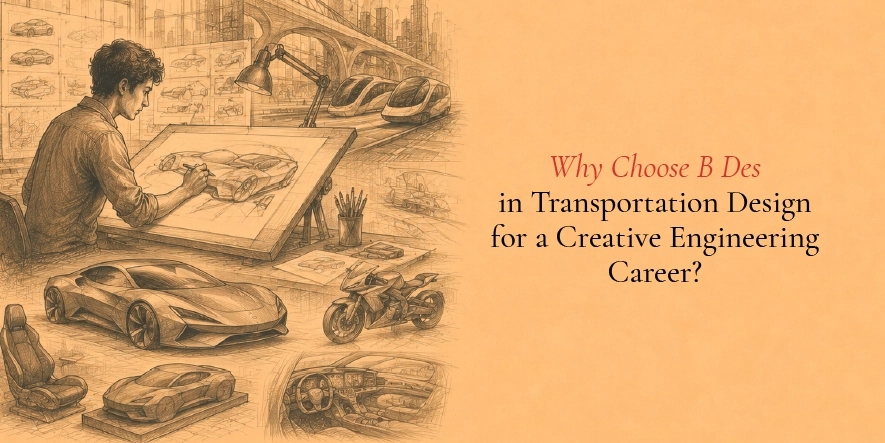
Transportation is changing at a rapid pace. Cars are becoming smarter, and EVs (electric vehicles) are growing. Mobility is no longer about moving from one place to another. It is about user experience, comfort, technology and design. This specific shift has created a massive demand for experts who can blend engineering thinking with creativity. This is where programmes like B Des in transportation become highly valuable. It can help learners gain a proper understanding of how transportation products are developed, produced, and visualised. For learners who are aiming for a creative engineering career, this course provides an exciting and clear path.
Transportation design keeps its focus on mobility systems and designing vehicles. The field consists of the following:
The field also blends problem-solving, creativity, aesthetics, and engineering logic. Students learn how to effectively design products that are visually appealing and functional. This is what makes this field so unique.
The B Des in transportation design stands out as an ideal option for many learners. However, here are some important reasons why students must opt for this course:
Many students want technical careers but also enjoy creativity. Transportation Design offers both. Through this field, students get to learn about the following:
They also understand how designs become real products. This makes it a creative engineering pathway, and it appeals to many young learners.
As transportation keeps evolving, electric mobility is also rising. Smart vehicles are becoming a lot more common, and autonomous systems are being developed. All these things are creating countless career prospects for learners.
These days, in the transportation domain, designers are needed for sustainable design solutions, vehicle interiors, future transport systems, electric vehicles and even mobility apps. The field is growing across the globe, which makes it a future-ready career.
Transportation Design starts with imagination. Students learn how to:
Creativity is encouraged throughout the course. That helps students build unique design identities and also builds confidence.
Also Read – How a B.Des. Transforms Ideas into Meaningful Designs
Learn Technical Design Skills
Creativity alone is not enough. Students must understand technical details. A good B Des course teaches:
Students learn sketching, rendering, digital modelling, layouts, and material studies as part of the curriculum. These skills are essential in the industry.
The best learning happens through practical work. Students should work on the following:
Institutes, such as ADYPU, have mentioned a real-world vehicle project where students work on commissioned vehicle design and build practical solutions. That creates valuable industry exposure and enhances job readiness.
Students should see how design works in the real world. Industry visits can help greatly. They help in showing the following:
Many institutes highlight major automobile brands and supplier ecosystems as part of the learning experience. That connects classroom learning with reality.
Transportation is becoming smarter. Students need exposure to:
Several institutes include AI in automotive design within the programme. That keeps students future-ready.
Transportation Design covers more than car bodies. Students learn about exterior design and interior design. The exterior design gives insights into the aerodynamics, style and form. Interior design, on the other hand, focuses on user experience, dashboard layouts, cabin comfort, and seating. This helps in creating much wider career prospects.
Also Read – How a B.Des in Interior Design Prepares You for a Fast-Evolving Industry
A B Des in transportation design stands out as an ideal option for learners who need technical knowledge and creativity. It can help build industry confidence, engineering awareness and design thinking. As mobility is constantly evolving, transportation design experts play an important part in shaping exactly how the world moves. This makes the programme future-focused and extremely relevant. ADYPU provides a dedicated B Des course in transportation design. It blends real vehicle assignments, industry visits and AI in automotive design. This future-focused and practical approach can help learners prepare for mobility and creative professions in the transportation domain.
What is the duration of a B Des in Transportation Design?
Learners can complete this programme within 4 years. It is also divided into 8 semesters.
Can students from any stream apply for Transportation Design?
Yes. Students from diploma, arts, commerce or science backgrounds can apply. This depends heavily on the eligibility regulations.
Do I need drawing skills before joining?
It might be good to have some basic sketching skills. However, most of the professional designs are developed under this programme.
What careers are available after Transportation Design?
Graduates can take job roles in EV design, concept design, automotive design, vehicle interiors, transportation consulting and mobility design.